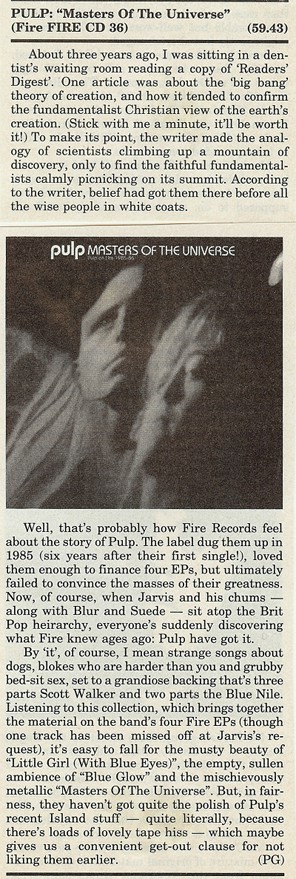
Masters of the Universe: Pulp on Fire 1985-6 (compilation)
Details
- Release date: 24 June 1994
- Label: Fire
- Formats: CD, LP, cassette
- Catalogue numbers: FIRE CD36, FIRE LP36, FIRE TC36
Info
Masters of the Universe is a compilation bringing together the four Pulp EPs/singles released on Fire Records between 1985 and 1987, with the exception of Silence (originally from the Master of the Universe single) which was left off at Jarvis Cocker's request.
The CD and LP covers are slightly different. On the CD, the logo and title are in the centre but on the LP they are at the right. Click here to see the LP cover.
The booklet contains lyrics for all songs. However, the lyrics for Master of the Universe are for the original version as found on the Freaks album, not the sanitised version that is included here.
Credits
- Sleeve design: The Designers Republic
- Photograph: Andy Gray
Tracklisting
- Little Girl (With Blue Eyes) (3:28)
- Simultaneous (4:09)
- Blue Glow (3:06)
- The Will to Power (3:25)
- Dogs are Everywhere (4:53)
- The Mark of the Devil (4:36)
- 97 Lovers (4:30)
- Aborigine (4:53)
- Goodnight (5:08)
- They Suffocate At Night (6:19)
- Tunnel (8:13)
- Master of the Universe (sanatised version)* (3:23)
- Manon** (3:33)
* The sanitised version replaces the words "masturbates" with "vegetates" and "comes" with "keeps". The original version can be found on the album Freaks.
** Although this should be the re-recorded version of Manon as featured on the Master Of The Universe single, it is in fact the original version and therefore, identical to the version that can be found on the Imminent 4 compilation.
Sleeve notes
Below are the sleeve notes Jarvis wrote for this compilation. Fire Records boss Clive Solomon found the thinly veiled negativity towards his label too much to stomach and not surprisingly refused to use them.
Tunnel – The True Story
"I first entered the tunnel on the 10th of July 1985. It was a sunny day, just a few rolled-out wispy clouds, and I was wearing my best suit. I saw the entrance and went in – simple as that. I had nothing else to do; I was bored. That was fifteen weeks ago and guess what? I'm lost - it's so bleeding dark in here, that's the problem. But I'm not alone - oh no, there must be hundreds, perhaps thousands, down here with me. We all mill around and bump into each other in the darkness. And the stench of a thousand unwashed bodies hangs in a thick fog. That's city dirt, fanny. I walk for at least eight hours every day but I've still never seen even the slightest glimmer of light that would tell me that I was nearing the end of the tunnel. Most others are content to just walk on the spot and hum to themselves, but I still make the effort. Hoping that one morning I will wake up in the sun with the sky blue above me and to be clean again. But I know I will never be clean again."
The above piece of writing appeared on the rear sleeve to “They Suffocate At Night” when it was first released in late 1986. At the time I paid no attention to the date I had chosen for my entrance into the tunnel – the 10th of July 1985 – I presumed I had simply picked it out of thin air. It wasn't until I was looking through some old papers that I realised the date's significance – amongst the papers was a copy of our first contract with Fire Records. It was dated – you guessed it – the 10th of July 1985. Had my unconscious mind been trying to tell me something I wonder? Hmmmmm.
These songs stem from probably the most depressing period in my life (bar 9 months I spent living in a tower block in Mile End in 1989) and I guess that this is reflected in the music and lyrics. I think we were all frustrated and angry in some way and you can hear that tension on these tracks. They were recorded in Sheffield in crappy little studios for hardly any money – oh yes, you know the score, but despite all that I think that there is still a spirit that comes through them.
Listening to them again after all this time was quite an experience – I felt by turns excited, surprised, embarrassed, sad and proud. At least we were striving for something, reaching for something that we couldn't always attain, but trying all the same. Such intensity can't last forever and this incarnation of Pulp disintegrated during the filming of the video that accompanied "They Suffocate At Night". I wrote the following notes at the end of 1987 to accompany the inclusion of "Little Girl" on a compilation LP.
"Well it's funny to think of it now but at one time it was everything. I mean, he never thought of anything else, not one little thing. So, of course, it couldn't stand the strain and it eventually broke. Obvious, you might say; but sometimes you don't think straight – y'know sometimes you're just plain stupid. Anyway, it's over now and it all seems like some kind of dream. Did you really think that you could live off love for the rest of your life? Go and get a job, mate. Get your head out of the clouds. Get back in line. Yes, we're back from the moon and in circulation again. Come on, let's go for a business lunch, let's have an office party. Come on then. Yes, I must dash, there's such a lot to be done and I've got to do it. Kiss goodbye to the past with a smile. That's the way, babe. Now we can watch dogs devouring little girls with blue eyes and not feel bad about it. Bye."
That kind of sums it up for me.
Jarvis Cocker, 19th April 1994.
Below are the sleeve notes that appeared in the end, written by Clive Solomon, head of Fire Records.
I was first introduced to Pulp one day back in 1984 when my good friend and founding father in Fire Records, journalist Johnny Waller, burst in to my flat / office, clasping a copy of their debut album "It". "Listen to this", he insisted - a collection of plaintive mainly acoustic ballads, the best of which exuded a songwriting craftsmanship which would not have been out of place on a Jimmy Webb record. Fact freaks should note that "Wishful Thinking" was recently accorded cult status with a dance treatment by Golden on St. Etienne's Icerink label.
Pulp, along with Blue Aeroplanes and Television Personalities, soon became just about my favourite band in the unknown universe. They were simply awesome, ranging from Scott Walker balladeering to post-punk, avant-garde aggressiveness. And then they were undeniably strange - stories abounded, but I liked to tell the tale about their singer Jarvis having fallen out of a third storey while doing a Spiderman impression and continuing to use his wheelchair as a stage prop long after he'd regained use of his legs.
Pulp signed to Fire and the lovably awkward and lyrically controversial "Little Girl With Blue Eyes", which I've always thought plucked its intro from James & Bobby Purify's pop soul classic "I'm Your Puppet", set an almost impossibly high standard to follow. But when they delivered their next, the delicately kitsch "Dogs are Everywhere", it only confirmed my suspicions that this was indeed a deeply disturbed but unique Sheffield pop group and try as I could to recall the last pop song on the subject matter of dogs, I gave up at Lobo's "Me And You And A Dog Named Boo". "They Suffocate At Night", a blackly humorous, lush ballad is truly sublime and this collection is rounded off with the near Heavy Metal delusions of "Master Of The Universe".
In keeping with Fire's desire to promote value for money 12" singles, these four Pulp singles each featured four tracks(1) ("Blue Glow" remains my personal favourite), all of which are gathered here, save for one, left off at the band's request. Shortly after, with a second album "Freaks" under their belts, but still almost a decade away from universal acclaim and pop stardom, Pulp departed to seek fame and fortune elsewhere. The freaks were to return to Fire some three years later, but that as they say, is another story.
Clive Solomon
(1) This is not correct. Dogs Are Everywhere featured five tracks, They Suffocate At Night featured two and Master Of The Universe featured three.
Reviews
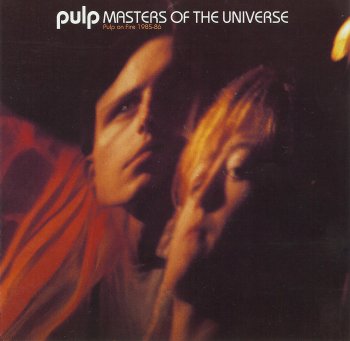
One can almost smell the fetid stench of "cash in" as "Masters Of The Universe" arrives on the racks. But not wanting to get all libellous and bitter that Pulp have had to wait 14 years before kissing the hem of that fickle mistress, Pop Stardom, one must thank the bods at Fire for supplying us with this compilation of Pulp's never-made-its.
There's something a wee bit perverse and voyeuristic about going back to listen to a band's embryonic sounds. "Masters Of The Universe" is no exception. And, although they satisfied my teenage heart, now they seem like thumbnail sketches for the shiny, multi-dimensional plastic pop of "His N' Hers".
"Little Girl With Blue Eyes" (banned from the Brighton Bead Shop stereo for the duration) is still Godlike after all these years. Girl is popular; girl meets boy; boy f***s up girl; girl goes quietly and deliciously mad.
But the rest of the album is engrained in mid-Eighties indie gloom, sawing guitars and a grey flannel feel to the songs that occasionally dissipates into a fey delicacy while Jarvis sings about ubiquitous canines. It's hard to believe that crimplene, sleazy sex wallah Jarvis Cocker can sing so dispassionately in a voice so flat it puts stale pancake batter to shame. Mind you, everyone sang like that in 1986. I think it was something in the water.
But I want all those sexy moans, heavy breathing and deadpan double entendres that provoke me into snogging people I shouldn't after a couple of listens to "His N'i Hers" and a surfeit of cheap wine.
"Masters Of The Universe" just results in the cat getting a perfunctory rub-down before I put him out for the night.
It appears that Pulp were initially less than chuffed at plans to release this 12-track anthology of 'The Early Years', seeing it as a rather dubious compliment to their rise through the ranks of indiedom into the 'proper' charts. But after the required amount of arm twisting, four of the band's early EPs have been dug out from the vaults, unearthing at least one Pulp classic, a few signs of early promise and a liberal sprinkling of more (ahem) experimental work.
If the '95 version is all about dressing up and showing out, then this album is more your night in with a bottle of Thunderbird and a packet of JPS. Whether the murky production obscures that famous pop-irony is arguable. Although there are occasional flashes, this is the sound of a band taking themselves just a touch too seriously, with Jarvis Cocker often meandering like a poor man's Scott Walker to a sombre drone that encapsulates the mood of mid-'80s art-rock.
Still, the epic sleaze of 'Little Girl (With Blue Eyes)' is a priceless treasure, featuring the unforgettable lines, "There's a hole in your heart and one between your legs/You've never had to wonder which one he's, going to fill/In spite of what he said". Honourable mentions also go to the faintly amusing 'Dogs Are Everywhere' and the sliding melody and showstopping arrangement of 'They Suffocate At Night'.
Patchy though it is, 'Masters Of The Universe' will serve the completists well, providing conclusive proof that Pulp are, indeed, the longest overnight sensations in history. Next up: 'Suede - The New Romantic Years' and Blur's 'Psychobilly Anthology'. (5)
About three years ago, I was sitting in a dentist's waiting room reading a copy of 'Readers' Digest'. One article was about the 'big bang" theory of creation, and how it tended to confirm the fundamentalist Christian view of the earth's creation. (Stick with me a minute, it'll be worth it!) To make its point, the writer made the analogy of scientists climbing up a mountain of discovery, only to find the faithful fundamentalists calmly picnicking on its summit. According to the writer, belief had got them there before all the wise people in white coats.
Well, that's probably how Fire Records feel about the story of Pulp. The label dug them up in 1985 (six years after their first single!), loved them enough to finance four EPs, but ultimately failed to convince the masses of their greatness. Now, of course, when Jarvis and his chums — along with Blur and Suede — sit atop the Brit Pop heirarchy, everyone's suddenly discovering what Fire knew ages ago: Pulp have got it.
By 'it', of course, I mean strange songs about dogs, blokes who are harder than you and grubby bed-sit sex, set to a grandiose backing that's three parts Scott Walker and two parts the Blue Nile. Listening to this collection, which brings together the material on the band's four Fire EPs (though one track has been missed off at Jarvis's request), it's easy to fall for the musty beauty of "Little Girl (With Blue Eyes)", the empty, sullen ambience of "Blue Glow" and the mischievously metallic "Masters Of The Universe". But, in fairness, they haven't got quite the polish of Pulp's recent Island stuff — quite literally, because there's loads of lovely tape hiss — which maybe gives us a convenient get-out clause for not liking them earlier.
(PG)